Landscape Dynamics
Environment and species composition vary greatly across a landscape. Do ecological dynamics – the emergent ‘clockwork’ – change from place to place as well?
To surmount the near-lack of data on this, we model landscape dynamics by leveraging spatial patterning, individual trait, and spatial time series data. This informs classical debates among competing hypotheses and reveals locations most sensitive to disturbance (climate change, invasions).
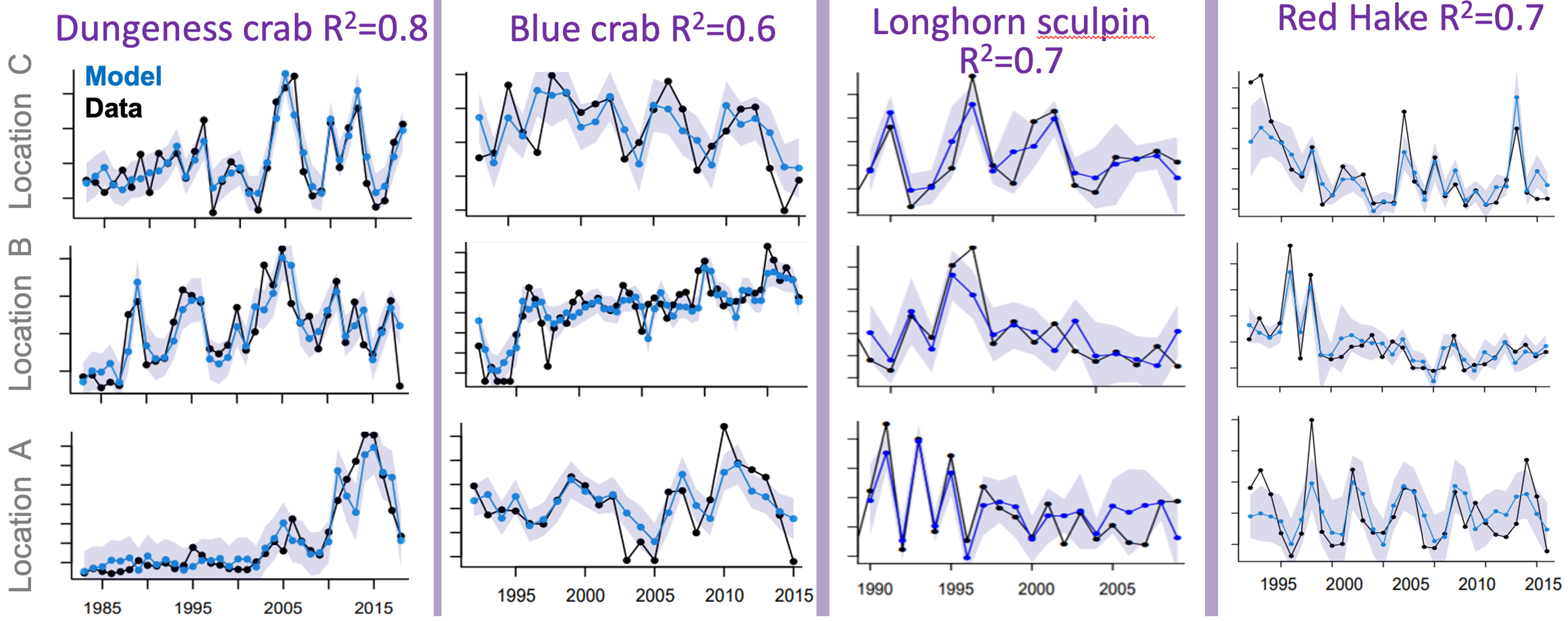
Large Marine Ecosystems. Across 36 species, we find that the processes underpinning population dynamics vary greatly among locations. This was often due to environmental gradients, for instance when all populations share a thermal response curve, but die-offs happen only in southern populations where absolute temperatures are greater. The ongoing loss of latitudinal temperature and productivity gradients on the US Northeast Shelf, then, could homogenize dynamics and cause frequent, large-scale population declines.
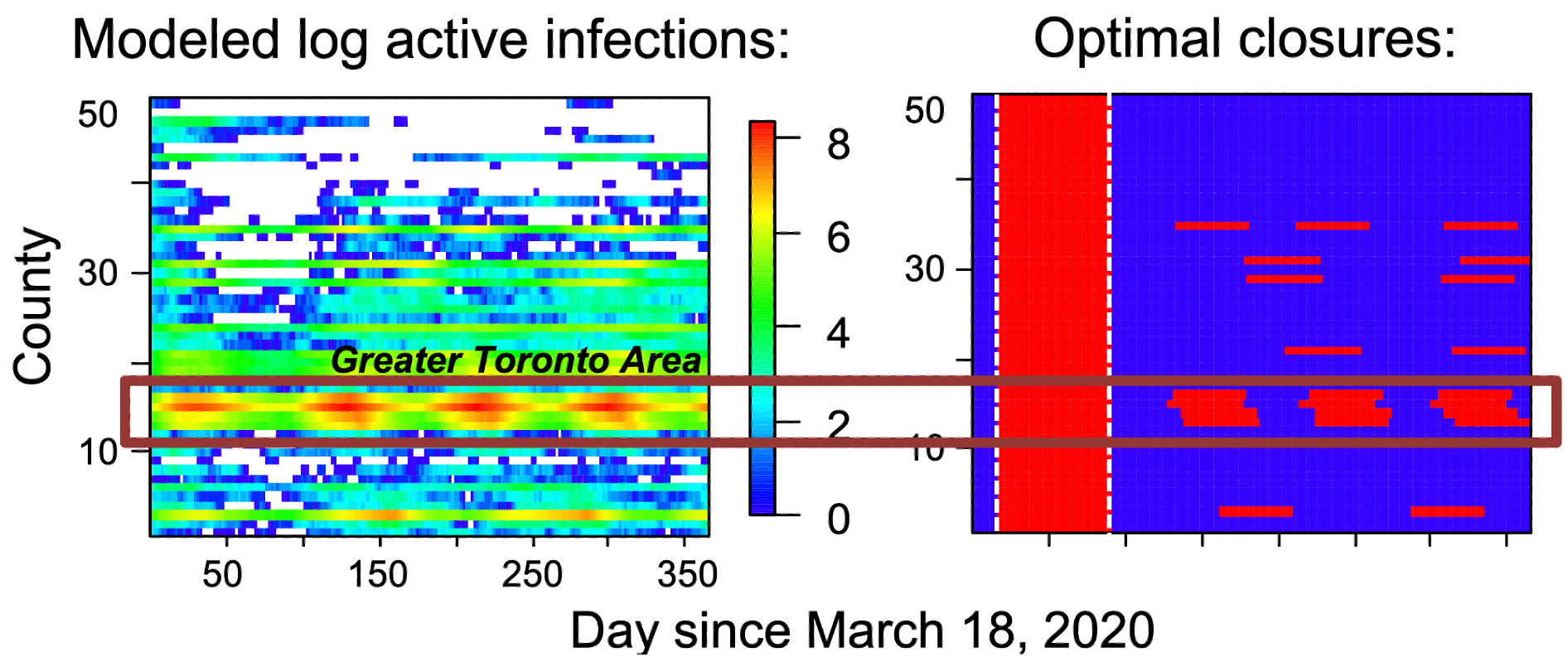
Epidemic management. Developing and fitting province-wide COVID-19 epidemic models in May 2020, we found slower epidemic growth in less densely populated areas. This was maintained even when simulating normal commuting patterns among counties. Thus, flexible county-by-county outperformed province-wide lockdowns.
Invasive species impacts. In the Great Lakes, quagga mussels now comprise c.a. 90% of all biomass. We quantify their food web impacts by fitting demographic models to mussel body size distributions. In resource-limited offshore habitats, models reveal a boom-and-bust dynamic: a huge initial cohort established high biomass, which now kills starvation-prone juveniles. Paradoxically, this means mussel consumption is now declining by ~35% while biomass continues to grow (Karatayev et al 2021; 2023; In prep).